2026 Top Sensor Street Light Types for Global Buyers

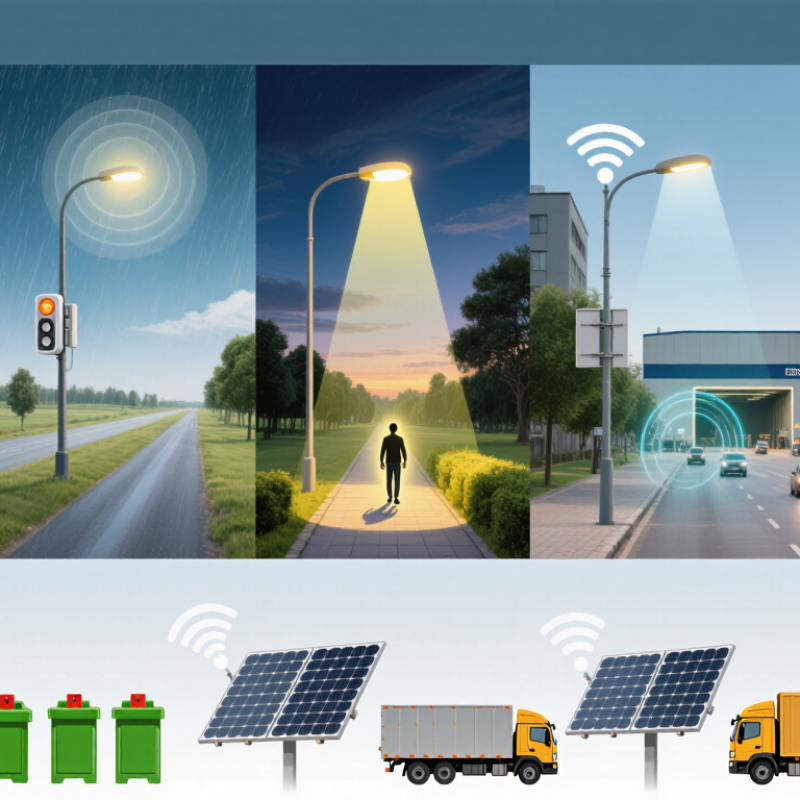
Choosing the right Sensor Street Light in 2026 requires more than comparing brightness, prices, or battery capacity. Global buyers now assess detection range, solar performance, LED efficiency, maintenance access, and long-term reliability. A light installed beside a quiet rural road faces different demands from one placed near a busy warehouse entrance.

This guide examines the main Sensor Street Light types available to international purchasers. It considers motion sensors, microwave sensors, infrared detection, hybrid systems, and smart networked designs. Each type has practical strengths and limitations. A microwave sensor may detect movement through light rain, while infrared sensing can respond more precisely to body heat. However, surrounding walls, vehicles, foliage, and temperature changes may affect performance.

Real installation experience shows that specifications rarely tell the whole story. A lamp rated for strong illumination may still fail when its solar panel sits beneath dusty branches. Battery replacement can also become expensive when access requires special equipment. Certification, weather resistance, warranty terms, and spare-part availability deserve equal attention. Local installation conditions and regional product requirements must be checked carefully.

No single model wins everywhere.

Buyers should compare detection zones, lighting schedules, charging conditions, and control options before selecting equipment. Some projects need simple standalone fixtures. Others benefit from remote monitoring and adjustable dimming. The most advanced system is not always the most dependable choice. This overview aims to support practical decisions with clear technical comparisons, realistic application examples, and a balanced view of emerging 2026 trends. Performance claims should still be verified through testing, supplier documentation, and local project evidence.

2026 Top Sensor Street Light Types for Global Buyers

Sensor Street Lights: Definition, Components, and Core Functions

Sensor street lights are outdoor luminaires that adjust brightness after detecting movement, vehicles, daylight, or changing weather. A typical unit combines an LED module, optical lens, power driver, motion sensor, photocell, controller, and weather-resistant enclosure. Some systems also include radar detection, wireless communication, solar panels, and battery storage.

The motion sensor is the street light’s practical “eye.” It can raise output when a cyclist approaches, then dim the road after several quiet minutes. Photocells prevent daytime operation, while controllers manage schedules, fault alerts, and dimming levels. The U.S. Department of Energy reports that LED lighting can use at least 75% less energy than incandescent technology and last much longer. Street-light savings depend on operating hours, dimming settings, and maintenance quality.

Real installations are less perfect. Rain, tree movement, parked vehicles, and insects may create false triggers. Sensor placement matters, especially on narrow roads with uneven traffic. The International Energy Agency has estimated that lighting represents roughly 15% of global electricity use, showing why smarter control remains valuable. However, a sensor does not automatically guarantee savings. Poor calibration can leave lights bright all night, while weak communication networks may delay fault reporting. Buyers should examine detection range, ingress protection, operating temperature, battery performance, and controller compatibility before selecting a sensor street light.

How Sensor Street Lights Detect Motion, Light, and Environmental Changes

2026 Top Sensor Street Light Types for Global Buyers

How Sensor Street Lights Detect Motion, Light, and Environmental Changes

Sensor street lights combine several detection methods to adjust illumination in real time. Passive infrared sensors notice body heat and movement from pedestrians, cyclists, and vehicles. Microwave sensors detect motion through radio waves and can cover wider areas. They may also respond to moving branches or heavy rain. Engineers often combine both technologies to reduce false triggers.

Light sensors measure ambient brightness with a photodiode or similar component. At dusk, the controller raises output gradually instead of switching suddenly. During bright mornings, it can dim or shut the lamp down. This reduces wasted energy. However, nearby shop windows, snow, or reflective surfaces may confuse the reading. Sensor placement matters more than many buyers expect.

Environmental sensors add another layer of control. Temperature data can warn operators about overheating or freezing conditions. Humidity and rain detection can support safer dimming strategies in exposed locations. Some systems monitor air quality, but their accuracy depends on calibration and enclosure design. A sealed housing protects electronics, yet it may trap heat. No sensor is perfect. A technically advanced light can still perform poorly when installed too high, aimed incorrectly, or left unmaintained. Buyers should review detection range, response time, operating temperature, ingress protection, and local electrical requirements before comparing equipment. Testing one sample through several weather conditions is wiser than trusting a brochure alone.

2026 Top Sensor Street Light Types for Global Buyers - How Sensor Street Lights Detect Motion, Light, and Environmental Changes
Sensor Street Light Type Primary Detection Method What It Detects Typical Detection or Control Range Main Advantages Key Limitations Typical Lighting Response Best-Fit Applications Important Selection Factors
PIR Motion Sensor Street Light Passive infrared sensing detects changes in infrared radiation emitted by moving people, vehicles, and animals. Human movement Vehicle movement Body heat changes Common outdoor detection distances are approximately 5–12 m, depending on lens design, mounting height, temperature, and walking direction. Low standby power consumption; simple control logic; cost-effective; generally resistant to radio interference. Performance can decrease when the target and background have similar temperatures. Detection is usually less reliable through walls, glass, dense vegetation, or in very hot weather. Maintains a low standby level and raises brightness when a moving heat source enters the detection zone. Residential roads, pedestrian paths, parks, entrances, and low-speed access roads. Check detection angle, lens coverage, mounting height, ambient temperature range, false-trigger control, and animal-detection behavior.
Microwave Radar Sensor Street Light Active microwave sensing transmits radio waves and analyzes reflected signals caused by movement or changes in distance. People Vehicles Direction of movement Speed changes Typical outdoor ranges are approximately 8–20 m for lighting control; the actual range depends on frequency, antenna pattern, mounting position, and configured sensitivity. Works in darkness and many weather conditions; can detect movement before a person reaches the light; often supports wider-area coverage than PIR. May detect movement through some non-metallic materials and can be affected by reflections, nearby moving objects, or incorrect sensitivity settings. Switches or dims the lamp according to detected movement, direction, or traffic activity. Roads, parking areas, industrial yards, tunnels, logistics zones, and locations requiring early detection. Review operating frequency, interference management, detection-zone adjustment, local radio regulations, and mounting orientation.
mmWave Radar Sensor Street Light High-frequency millimeter-wave radar measures reflected signals to identify motion, distance, and in some systems the presence of relatively stationary targets. Motion Presence Distance Traffic flow Common configured detection zones range from approximately 10–30 m, with the final range determined by antenna design, software settings, and installation height. Fine motion sensitivity; capable of multi-zone detection; supports more detailed traffic or occupancy information than basic motion sensors. Usually costs more than basic PIR; requires careful commissioning; metal structures and complex surroundings can create reflections or dead zones. Provides gradual dimming, presence-based control, zone-based lighting, or traffic-responsive brightness. Smart roads, urban corridors, intersections, parking facilities, and projects requiring data-rich control. Evaluate detection resolution, privacy requirements, cybersecurity, edge-processing capability, communication protocol, and local spectrum compliance.
Photocell or Ambient-Light Sensor Street Light Measures surrounding illuminance and compares it with a programmed threshold for dusk-to-dawn operation. Daylight level Dusk Dawn Overcast conditions Controls operation across the full outdoor daylight cycle rather than using a fixed motion-detection distance; threshold settings are commonly selected around local night/day requirements. Automatic seasonal operation; simple installation; reduces daytime energy waste; does not require a moving target. Can be affected by direct lamp glare, nearby building lights, dirt on the sensor window, snow, or poor placement. It does not detect movement. Turns the light on at low ambient illuminance and off after daylight returns, often with a built-in time delay to prevent rapid switching. General street lighting, rural roads, public squares, campuses, and solar street lights. Check sensor orientation, shielding from the lamp itself, illuminance threshold, time delay, ingress protection, and cleaning access.
Ultrasonic Motion Sensor Street Light Emits ultrasonic sound waves and detects changes in the reflected echo caused by nearby objects or movement. Nearby movement Object presence Distance changes Outdoor detection is commonly limited to approximately 3–8 m because wind, rain, temperature, and open-air conditions can reduce effective range. Can detect objects without relying on heat contrast; useful for short-range and controlled detection zones. Wind, rain, airflow, soft surfaces, obstructions, and temperature changes can affect sound transmission and accuracy. Less suitable for exposed, long-distance road detection. Raises brightness when an object enters a short-range zone and returns to a lower level after a delay. Covered walkways, building entrances, sheltered parking areas, service lanes, and compact pedestrian zones. Confirm weather exposure, acoustic environment, target distance, sensor protection, mounting direction, and minimum target size.
Camera-Based Vision Sensor Street Light Uses an image sensor and software algorithms to analyze visual changes, object categories, movement, or traffic conditions. People Vehicles Bicycles Traffic conditions Typical useful distances can range from approximately 10–50 m or more, depending on lens angle, image resolution, lighting level, weather, and analytics software. Supports classification, counting, occupancy analysis, incident detection, and advanced adaptive-lighting strategies. Performance may decline in glare, fog, heavy rain, snow, darkness, obstruction, or poor camera alignment. Requires careful privacy, data-security, and maintenance planning. Adjusts brightness or lighting zones according to classified road users, traffic volume, or detected events. Smart-city corridors, intersections, transport hubs, security-sensitive sites, and data-driven traffic management. Assess privacy compliance, data storage, processing location, night vision, image quality, network bandwidth, cybersecurity, and maintenance requirements.
Environmental Sensor Street Light Combines one or more sensors that measure environmental conditions and may integrate with a lighting controller. Temperature Humidity Rain Air quality Flood or water level Detection range depends on the measured variable: temperature and humidity are local measurements, while rain, air-quality, or water-level sensing depends on sensor placement and calibration. Supports weather-responsive lighting, asset protection, environmental monitoring, and combined smart-infrastructure functions. Environmental measurements do not directly identify a person or vehicle. Sensors require calibration, protection from contamination, and suitable placement for representative readings. Can increase brightness during severe weather, flooding risk, or reduced visibility when integrated with appropriate control rules. Flood-prone roads, coastal areas, tunnels, industrial sites, smart campuses, and municipal monitoring networks. Verify measured parameters, calibration interval, operating temperature, enclosure rating, sensor placement, data protocol, and local environmental regulations.
Multi-Sensor Adaptive Street Light Combines ambient-light sensing with PIR, radar, camera, or environmental inputs through a local or networked lighting controller. Daylight Motion Traffic Weather System status Overall coverage is determined by the individual sensors; a typical installation may combine daylight control with motion zones of approximately 5–30 m. More accurate control; supports layered safety strategies; can reduce energy use while maintaining higher brightness when activity or risk is detected. Higher system complexity, installation cost, commissioning effort, and interoperability requirements. Incorrect sensor priority rules may cause unwanted switching. Uses schedules, daylight thresholds, motion levels, traffic conditions, and environmental events to select different brightness levels. Smart highways, urban districts, airports, large campuses, public infrastructure, and energy-optimization projects. Confirm controller logic, sensor compatibility, interoperability standards, communication reliability, fail-safe behavior, maintenance access, and total lifecycle cost.
Data shown are typical engineering ranges and characteristics for outdoor sensor-lighting applications. Actual performance varies with sensor model, frequency, lens or antenna pattern, mounting height, weather, surrounding structures, firmware settings, and local regulations. A site survey and commissioning test should be completed before final procurement.

Main Sensor Street Light Types for Different Global Applications

2026 Top Sensor Street Light Types for Global Buyers

Main Sensor Street Light Types for Different Global Applications

Sensor street lights should match traffic, weather, and local infrastructure. Photocell sensors suit residential roads and parking areas. They switch lights at dusk and dawn with simple control. PIR sensors detect body heat and movement near walkways, campuses, and low-traffic lanes. Microwave and radar sensors perform better on wider roads. They can detect vehicles through light rain and dust, although installation angles matter. Networked adaptive lights combine sensors, dimming, and remote monitoring. They fit smart-city corridors and major intersections.

The U.S. Department of Energy reports that LED street lighting can reduce energy use by roughly 50% to 70%. Sensor-based dimming may create additional savings, but results vary by traffic patterns. The International Energy Agency also identifies efficient lighting as a practical route for reducing electricity demand. However, reported savings often assume correct commissioning. Real roads are less predictable. A PIR sensor may miss a cyclist moving quickly. A radar unit may react to roadside movement. That assumption deserves review.

Tips: Check detection range at the actual mounting height. Test sensors during fog, rain, and summer heat. Choose sealed housings for coastal or dusty areas. Ask suppliers for measured response times, standby consumption, and maintenance records. Avoid selecting the most advanced sensor automatically. A simple photocell may outperform a connected system on a quiet rural road. Reliable performance matters more than impressive specifications.

Key Factors for Comparing Performance, Energy Use, and Installation

2026 Top Sensor Street Light Types for Global Buyers

Key Factors for Comparing Performance, Energy Use, and Installation

Sensor street lights commonly use passive infrared, microwave, or dual-technology detection. Passive infrared sensors respond well to people and vehicles in defined zones. Microwave sensors can detect movement through light rain, but nearby traffic may create false triggers. Dual sensors improve accuracy, although they usually require more careful adjustment.

Compare performance through detection range, response time, dimming control, and recovery speed. A light that reaches full brightness slowly can feel unsafe near crossings. Check tests at different temperatures, mounting heights, and weather conditions. Higher sensitivity is not always better. In quiet streets, false activation wastes energy and annoys residents.

Energy savings depend on the complete lighting profile, not the sensor alone. Review standby wattage, maximum output, dimming percentages, and nightly operating hours. Installation also matters. Technicians need clear wiring, adjustable brackets, sealed connectors, and accessible settings. An IP-rated enclosure helps protect the unit, but ratings do not replace proper sealing during installation. Local voltage, pole spacing, road width, and maintenance access should guide product selection. A small trial section can expose problems before a large purchase. It may feel slower, but early testing often prevents expensive changes.

Global Buyer Guide to Standards, Maintenance, and Smart Integration

For global buyers, sensor street lights should be selected by road conditions, not catalogue claims. Photocells suit basic dusk-to-dawn control, while PIR and microwave sensors support dimming near pedestrians or vehicles. Radar performs better in rain, dust, and wider lanes, but false triggers remain possible. Camera-free systems usually simplify privacy reviews.

The International Energy Agency’s Energy Efficiency 2023 report estimates that lighting uses about 15% of global electricity. The U.S. Department of Energy has reported potential energy savings of roughly 50% to 70% after LED streetlight upgrades. Sensor controls can increase savings, but only when detection zones match traffic patterns. A quiet industrial road needs different settings than a crowded junction. Small errors matter.

Check IEC 60598-1 for luminaire safety, IEC 60598-2-3 for road lighting, and local electromagnetic compatibility requirements. For networked fixtures, buyers should examine Zhaga-D4i or NEMA ANSI C136.41 compatibility, cybersecurity controls, and open data access. TALQ-compliant interfaces may help connect different management systems, though actual interoperability still needs site testing. The Global Lighting Association’s market guidance stresses maintenance planning and lifecycle performance. Keep spare sensors, surge protection, and replacement seals available. Dust changes readings. Batteries also age faster than expected. A short pilot is useful, but it can hide seasonal failures. Test during rain, winter darkness, and heavy traffic before approving volume orders.

2026 Top Sensor Street Light Types for Global Buyers

Typical practical detection distances for common sensor technologies used in outdoor street-lighting applications. Actual performance depends on mounting height, lens design, weather, traffic speed, and local regulations.

Global buyer guidance: PIR sensors are energy-efficient for pedestrian areas, microwave sensors generally provide longer detection distances, ultrasonic sensors can perform well in controlled zones, and dual-technology sensors help reduce false triggering. For outdoor projects, verify enclosure protection under IEC 60529, luminaire safety under IEC 60598-1 and IEC 60598-2-3, mechanical impact resistance under IEC 62262, photobiological safety under IEC 62471, and lighting performance under the applicable EN 13201 or local roadway-lighting requirements.

Values shown are non-brand, indicative engineering benchmarks for early-stage product comparison, not guaranteed operating limits or mandatory standards.

Call (416) 661-5667